Two weeks ago, I shot a townhome in Falls Church for an agent I’d never worked with before. Nice property — nothing extraordinary, but well-maintained, good neighborhood, priced right. She’d had it listed for six weeks with phone photos and a lockbox. Twelve showings. Zero offers.
We reshot it with professional photos, added a 30-second Reel, a floor plan, and drone aerials. She relisted on Thursday. By Monday she had three offers, one above asking.
The home didn’t change. The market didn’t change. The marketing changed.
I hear some version of this story every month. And while it’s tempting to chalk it up to better photos (which it partly is), there’s a bigger pattern underneath. The gap between agents who invest in how they market and agents who don’t has gotten wider — and in 2026, it’s becoming a gap that’s very hard to close.
NAR is projecting existing-home sales to surge 14% this year. That sounds like good news, and it is. But more inventory also means more competition for buyer attention. There are nearly two million licensed real estate agents in the United States right now. More homes to sell, more agents fighting for every one of them. The agents winning aren’t doing it with secret tactics or massive budgets. They’re doing it by paying attention to what’s actually working — and letting go of what isn’t.
After working with over a thousand agents and photographing more than four thousand properties across DC, Virginia, and Maryland, I’ve watched these shifts happen up close. Here’s what’s actually moving the needle right now — and what you can do about each one this week.
1. Short-Form Video Went From “Nice to Have” to Non-Negotiable
Let me be direct: if you’re not producing short-form video in 2026, you’re invisible to a growing segment of your market.
This isn’t about becoming a TikTok influencer or dancing in front of a ring light. It’s about meeting buyers and sellers where they already are — scrolling through 15-to-60-second vertical videos on Instagram Reels, TikTok, and YouTube Shorts. That format is now the default way people consume content on their phones. And 82% of real estate businesses are already marketing through social media. The ones winning aren’t just posting listing photos with a caption. They’re creating video.
The numbers tell the story clearly: listings with video receive 403% more inquiries than those without. That’s not a marginal improvement. That’s a fundamentally different level of buyer attention.
And it’s not just about listings. The agents building the strongest brands are using short-form video for everything:
- Quick property walkthroughs — 30-second tours that give buyers a feel for the flow of a home
- Market updates — “Here’s what happened in Arlington this month” in 45 seconds. It positions you as the local expert
- Behind-the-scenes content — showing up at a photo shoot, prepping for an open house, celebrating a closing. People connect with people, not logos
- Tips and advice — staging tricks, first-time buyer mistakes, what to look for in an inspection. Educational content builds trust before a prospect ever contacts you
Instagram Reels average a 3.0% engagement rate for real estate agents — that’s significantly higher than static posts. And here’s the real power: short-form video reaches people who don’t follow you yet. The algorithm pushes Reels to new audiences in a way that standard posts simply don’t.
The practical side
You don’t need expensive equipment. Your phone shoots great video. But you do need captions or on-screen text on every single video — most people scroll with sound off. You need consistency (three to five videos per week beats one viral attempt per month). And you need to show your face and your voice. Agents who put themselves on camera build familiarity and trust at a rate that polished but impersonal content can’t match.
For property-specific video — cinematic walkthroughs, drone footage, lifestyle content — professional production makes a real difference. A well-produced 60-second listing reel shot by someone who understands composition, lighting, and pacing stands out in a feed full of shaky phone clips. That’s the kind of content that gets shared, saved, and remembered. Here’s how to think about videography for your listings →
What to do this week: Post one short-form video. It doesn’t have to be perfect. Film a 30-second walkthrough of your next open house, add captions, and post it as a Reel. Then do it again next week. The agents who start building this muscle now will have a library of content — and an audience — by the time their competitors realize they’re behind.
2. Professional Media Is Widening the Gap Between Top Agents and Everyone Else
This one gets more true every year, and the data keeps getting harder to ignore.
Here’s the stat that should make every agent sit up: agents who use professional photography earn double the average gross commission income compared to agents who don’t. Double. Not a slight edge — a fundamentally different business outcome.
And when you look at the listing-level impact, the numbers are just as striking:
- Homes with professional photos sell 32% faster — 89 days on market compared to 123 days with standard photos
- Professional photography generates 118% more online views. More than double the eyeballs on your listing
- Professionally photographed homes close for $3,400 to $11,200 more depending on price range
- Listings with quality images get 137% more saves on Zillow and Realtor.com — and saves turn into showings
I’ve written in depth about the data behind professional photography ROI, and honestly, those numbers have only gotten stronger over time.
But photos alone aren’t enough anymore
The shift I’ve watched happen over the last two years is this: photos used to be the whole media package. Now they’re the baseline. The agents winning listings — especially in competitive markets — are showing up with a complete media strategy.
Drone photography is a perfect example. Homes with aerial photos sell 68% faster, and 52% of REALTORS now use drone photography according to NAR’s latest data. That’s up significantly from even a few years ago. Aerial shots answer questions buyers didn’t know they had — lot size, proximity to parks, neighborhood context, the view from above. Our complete drone photography guide covers this in detail →
3D virtual tours are another accelerator. They’re especially powerful for relocation buyers (huge in the DC market with government and military moves), luxury properties, and vacant homes where scale is hard to judge from flat images. 82% of sellers say they’d switch to an agent who offers 3D tours. That number should get your attention if you’re competing for listings. More on what Matterport brings to a listing →
Video walkthroughs keep compounding the advantage. 73% of sellers say they prefer agents who use video in their marketing. We covered the engagement numbers in Section 1, but it’s worth repeating in context: video doesn’t just boost your brand — it directly accelerates individual listings.
Virtual staging is another trend that’s gone from niche to mainstream. Staged homes spend 73% less time on market, and virtual staging does it at a fraction of the cost of traditional staging — starting around $24 per photo versus $1,500 to $5,000 per month for furniture rental. For vacant properties, this is becoming standard practice. We’ve had agents in Potomac and Bethesda tell us virtual staging was the single thing that turned a stale listing around.
The bundled approach
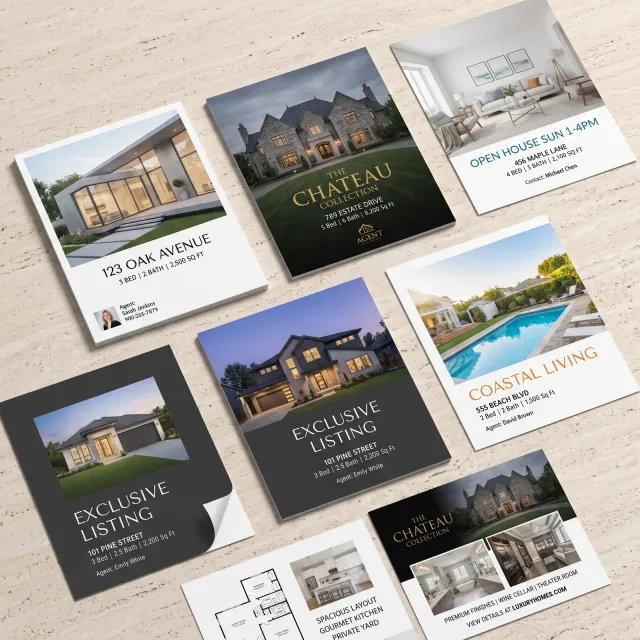
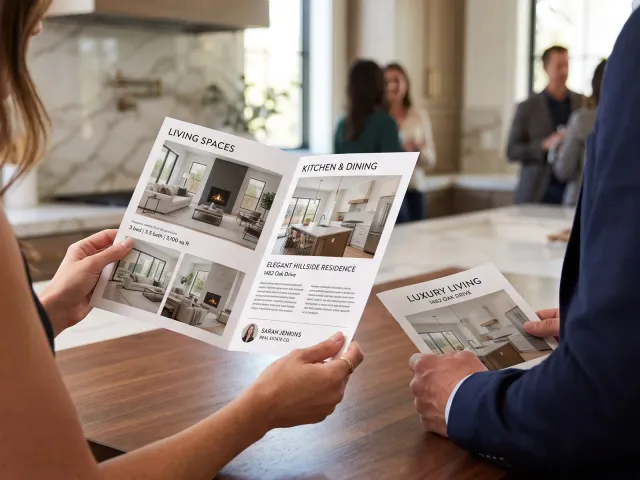
Here’s what I see the smartest agents doing: they’re not booking photography one day, then drone another day, then scrambling to find a videographer for the tour. They’re bundling everything into a single shoot. One appointment, one team, and within 24 hours they have a complete marketing package — photos, drone aerials, video walkthrough, floor plan, and a 3D tour.
The efficiency matters. But more importantly, the consistency matters. When every piece of media is shot on the same day by people who work together, the quality and feel is cohesive across every platform where that listing appears.
The ROI at a glance
Here’s the math, using a $550,000 home — fairly typical for the DC, Virginia, and Maryland market:
| Strategy | Result |
|---|---|
| Phone photos + MLS only — $0 | Baseline: average days on market, average online views, no competitive advantage |
| Professional photography | Sells 32% faster, 118% more views, closes $3,400–$11,200 higher |
| Full media package (photos, drone, video, floor plan, 3D tour) — $399–$899 | All of the above compounded: 68% faster from drone, 403% more inquiries from video, 49% more qualified leads from 3D tour |
| One price reduction (3% on a $550K home) — $16,500 | Signals “something’s wrong” to the market, resets comps for the neighborhood |
A full professional media package costs roughly 3-5% of what a single price reduction costs. And unlike dropping the price, better marketing raises the listing’s ceiling instead of lowering the seller’s bottom line. That’s the math that should make this decision easy.
What to do this week: Look at your next listing appointment. Instead of quoting just photography, present a complete media package. Show the seller the data above. When they see that a $500 investment outperforms a $16,500 price cut, the conversation shifts.
3. AI Has Gone From Buzzword to Daily Tool
A year ago, “AI in real estate” was mostly a conversation about what might happen someday. Now it’s a conversation about what agents are already doing every morning.
Nearly 70% of agents have increased their marketing spend, with larger shares directed toward automation and data-driven tools. And brokerages with integrated AI-powered CRMs have reportedly seen their marketing cycles double in speed.
But here’s the honest take: AI in real estate isn’t about robots replacing agents. Not even close. The agents using AI well are using it to eliminate the drudge work so they can spend more time on what actually builds their business — relationships, local knowledge, and showing up for their clients.
Where AI is actually making a difference right now
- Listing descriptions. Writing 30 unique, compelling property descriptions a month is exhausting. AI drafts them in seconds. You still need to edit — AI doesn’t know that the morning light in that kitchen is the real selling point — but it eliminates the blank-page problem
- Email follow-ups. Automated, personalized drip sequences that feel human. AI can tailor the message to where someone is in their search without you manually tracking every interaction
- Social media content. Generating caption ideas, content calendars, and post variations. It’s not about letting AI post for you — it’s about never running out of ideas for what to post
- Lead qualification. Chatbots that can answer basic questions on your website at 2 AM, qualify leads based on their responses, and route serious prospects to you
- Market analysis. Predictive analytics that show where prices and demand are heading, helping you advise sellers on timing and help buyers identify emerging neighborhoods
What AI can’t do
AI can’t walk a nervous first-time buyer through a home and read their body language. It can’t negotiate a tricky inspection response with the finesse that comes from a hundred past deals. It can’t tell a seller that their price is too high in a way that preserves the relationship. And it can’t replace the trust that comes from an agent who genuinely knows the neighborhoods they serve.
The agents who treat AI as a replacement for expertise are going to learn that lesson the hard way. The agents who treat it as an efficiency multiplier — doing in 20 minutes what used to take two hours — are going to out-produce everyone around them. More on AI tools for real estate marketing →
What to do this week: Pick one repetitive task that eats your time — writing listing descriptions, social media captions, or follow-up emails — and try using an AI tool for it. ChatGPT, Claude, Gemini — any of them will work. Spend one hour learning the basics. You’ll get that hour back ten times over in the first month.
4. Your Online Presence Is Your Listing Presentation
Here’s a number that should frame every marketing decision you make: 97% of home buyers start their search online. That’s essentially everyone. And 43% of buyers say they start specifically with an online search — before they talk to an agent, before they drive through neighborhoods, before they do anything else.
Your online presence isn’t supporting your business. It IS your business — at least the first impression of it.
Local search is the real battleground
Google’s Local Pack — those three business listings that appear at the top of local search results — captures 44% of all local search clicks. And organic search drives 94% of total search traffic. That first organic result? It earns roughly 27.6% of all clicks.
Here’s what this means in practice: when a homeowner in McLean types “best real estate agent in McLean” or a relocating family searches “top listing agent in Arlington VA,” Google isn’t showing them the agent with the most experience. It’s showing them the agent with the strongest online presence in that specific area.
The agents dominating local search in markets like DC, Bethesda, Fairfax, and Alexandria aren’t doing anything exotic. They’re doing the basics consistently:
The specifics that actually move rankings
- Google Business Profile that’s actively worked, not just claimed. Post weekly updates. Respond to every review. Add photos from recent shoots — Google rewards fresh, relevant visual content. Most agents set up their profile once and forget it. That’s an opportunity for you
- Hyperlocal content. Not generic “tips for selling your home” articles. Neighborhood-specific market updates, school district guides, “what it’s like to live in Reston” posts. This is how you own the search results for your specific farm area. The agents who write about Tysons Corner specifically will outrank the agents who write about “Northern Virginia” generally
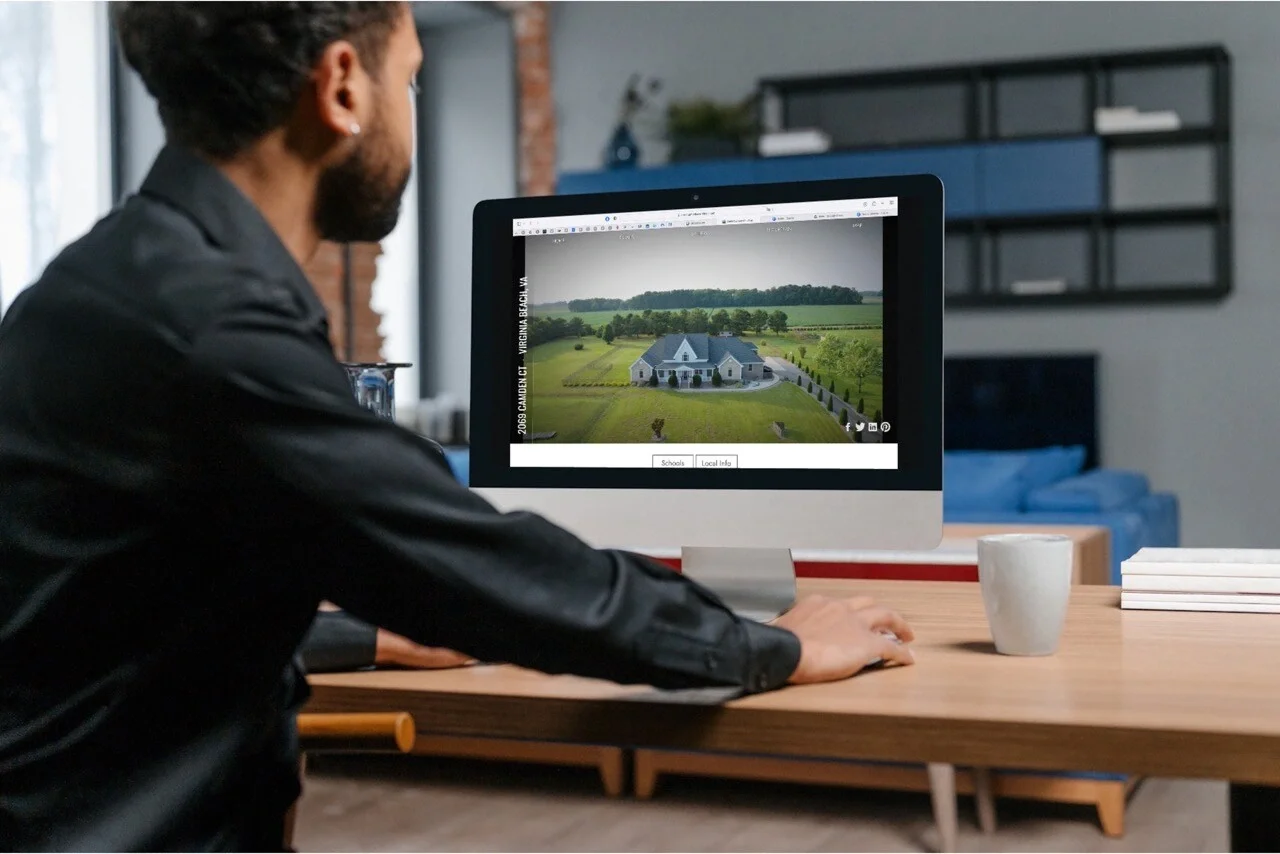
- Single property websites for each listing. Starting at just $13, a dedicated page for one listing gives you a clean, branded URL to share everywhere — and it’s another indexed page building your online footprint. Top agents in our market use these on every listing, not just the luxury ones
- Your listings ARE your portfolio. This is where everything connects. The professional photos, drone shots, and video walkthroughs from your listings don’t just sell those individual homes — they become your public body of work. When a potential seller scrolls through your last ten listings and every single one looks exceptional, that’s more persuasive than any pitch deck or testimonial
The agents who treat every listing’s media as a branding investment are building something compounding. Six months of consistently beautiful listings creates a portfolio that markets you 24/7, across every platform, to every potential client who looks you up.
What to do this week: Google yourself. Search “real estate agent [your neighborhood]” and see where you show up. Then check your Google Business Profile: is the phone number current? Are there photos from the last 90 days? Have you responded to your reviews? These are free fixes that directly affect whether new prospects find you.
5. The One-Team Advantage: Why Agents Are Simplifying Their Vendor Stack
Here’s something I hear from agents constantly: “I’m spending more time coordinating vendors than I am selling houses.”
It makes sense. In the old model, marketing a listing at a high level meant booking a photographer, then a separate videographer, then a drone operator, then a Matterport tech, then maybe a virtual stager. Five vendors. Five schedules. Five invoices. Five different levels of quality and five different turnaround timelines.
For a single listing, that’s a headache. For an agent doing 20 or 30 deals a year, it’s a part-time job.
The trend I’m seeing — and it’s accelerating fast — is agents consolidating their media under one provider. One team that handles photography, drone, video, 3D tours, floor plans, and virtual staging. One booking. One point of contact. One delivery.
Why this matters beyond convenience
- Consistency. When one team shoots everything, the visual quality and feel is uniform across every piece of media. Your brand looks cohesive
- Speed. A single appointment covers everything. Next-day delivery means your listing goes live with a complete marketing package within 48 hours of the shoot
- Cost efficiency. Bundled packages cost significantly less than booking five separate vendors. The savings add up fast across a full year of listings
- Time savings. Agents who switch to a one-team model report saving 3 to 5 hours per listing on vendor coordination alone. Over a year, that’s hundreds of hours you get back for prospecting, client service, and actually running your business
This isn’t a minor operational improvement. It’s a structural advantage. The agent who can list a property and have a complete, professional media package live within a day is going to outpace the agent who’s still chasing down three vendors for delivery a week later.
I’ll be transparent — this is the model we built Umedia around, and it’s obviously what we believe in. But you don’t have to work with us for this trend to apply. Whatever providers you use, the question worth asking is: Am I spending more time coordinating my marketing than actually marketing? If the answer is yes, simplification is the move.
What to do this week: Look at your last three listings. How many separate vendors did you coordinate? How many hours did that take? If the number surprises you, start researching all-in-one providers in your market. Ask for sample packages, compare pricing against what you’re currently paying per-service, and run the math on your time.
6. The Agents Who Are Struggling — And What They’re Getting Wrong
I don’t want to sugarcoat this part. The market is tough for a lot of agents right now, and it’s worth being honest about why.
Remember the nearly two million licensed agents I mentioned earlier? The share of them considering leaving the industry has climbed significantly. The NAR settlement changed buyer agent compensation models, adding uncertainty to an already competitive landscape. Housing affordability is the top concern for 56% of real estate firms heading into 2026.
More competition. More uncertainty. More pressure.
But here’s what I’ve noticed from working with hundreds of agents across different experience levels and markets: the agents struggling the most tend to share the same patterns.
Pattern 1: They’re relying entirely on referrals and past clients
Referrals are the foundation of most established agents’ businesses — 40 to 41% of business for experienced agents comes from repeat clients and referrals. But the agents who treat referrals as their only source of business are the ones who panic when the pipeline dries up. The top agents use referrals as a floor, not a ceiling. They’re actively building their brand so new prospects find them organically.
Pattern 2: They’re resisting technology
I get it — there’s fatigue around “the next big thing.” But the agents who are still listing homes with phone photos and a yard sign in 2026 are leaving money on the table. Not just for themselves, but for their sellers. When the data consistently shows that professional media sells homes faster and for more money, choosing not to use it is a hard position to defend in a listing presentation.
Pattern 3: They’re treating marketing as an afterthought
Marketing isn’t something you do after you get the listing. It’s how you get the listing. Sellers are evaluating agents based on how they market other people’s homes. 35% of sellers consider an agent’s reputation as their primary selection factor. And in the age of social media, your reputation is your visible body of work.
The agents who are thriving in this market share a different set of patterns: they invest in their brand, they embrace technology that saves time and improves results, and they treat every listing’s marketing as a reflection of their professionalism. It’s not complicated. But it does require intentionality.
The Bottom Line
I want to be honest about something. Not every trend on this list will matter equally for every agent. If you’re a solo agent doing eight deals a year in a suburban market, your priorities look different from a team lead running 60 transactions across the DMV. That’s okay. The point isn’t to do everything — it’s to stop doing nothing new.
Here’s what I’d tell any agent who asked me where to start:
- If you’re doing zero video: Film one Reel this week. Just one. It’ll be awkward. Post it anyway. The second one will be better
- If you’re still using phone photos: Book a professional shoot on your next listing. Just photos, nothing fancy. See what happens to your online engagement. The data says it’ll double. I’ve watched it happen hundreds of times
- If you’re overwhelmed by the tech: Pick one AI tool and spend an hour with it. Use it for listing descriptions or social captions. That’s it. Don’t try to overhaul everything at once
- If you’re already doing all of this: Look at bundling. Are you getting drone, video, floor plans, and 3D tours on every listing, or just the expensive ones? The agents who treat every listing like a luxury listing — regardless of price point — are the ones building the strongest brands
The market in 2026 is rewarding agents who show up prepared. More inventory means more competition for buyer attention. More agents means more competition for listings. The ones who stand out will be the ones whose marketing makes it obvious — at first glance, on a phone screen, in a three-second scroll — why they’re the right choice.
That agent I mentioned at the beginning? The one in Falls Church with the townhome that sat for six weeks? She called me last week to book three more listings. Not because I gave her a sales pitch, but because her sellers saw the difference. Their home sold. The neighbors noticed. Now they’re calling her.
That’s how this works. Great marketing doesn’t just sell the listing in front of you. It sells the next one, and the one after that.
Umedia provides professional real estate photography, drone, video, 3D virtual tours, virtual staging, floor plans, and property websites across DC, Virginia, and Maryland — all delivered next day. See our packages and pricing → or book a shoot today.