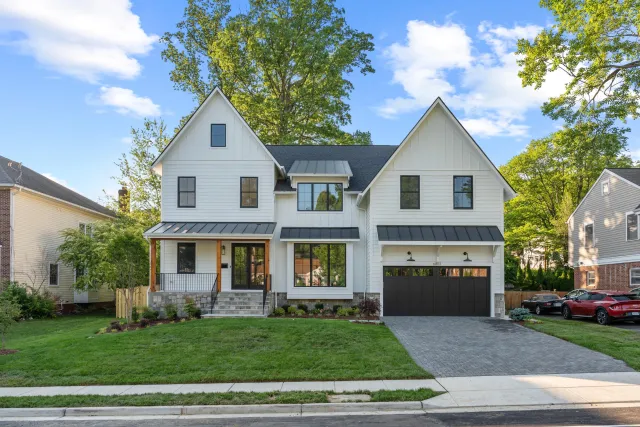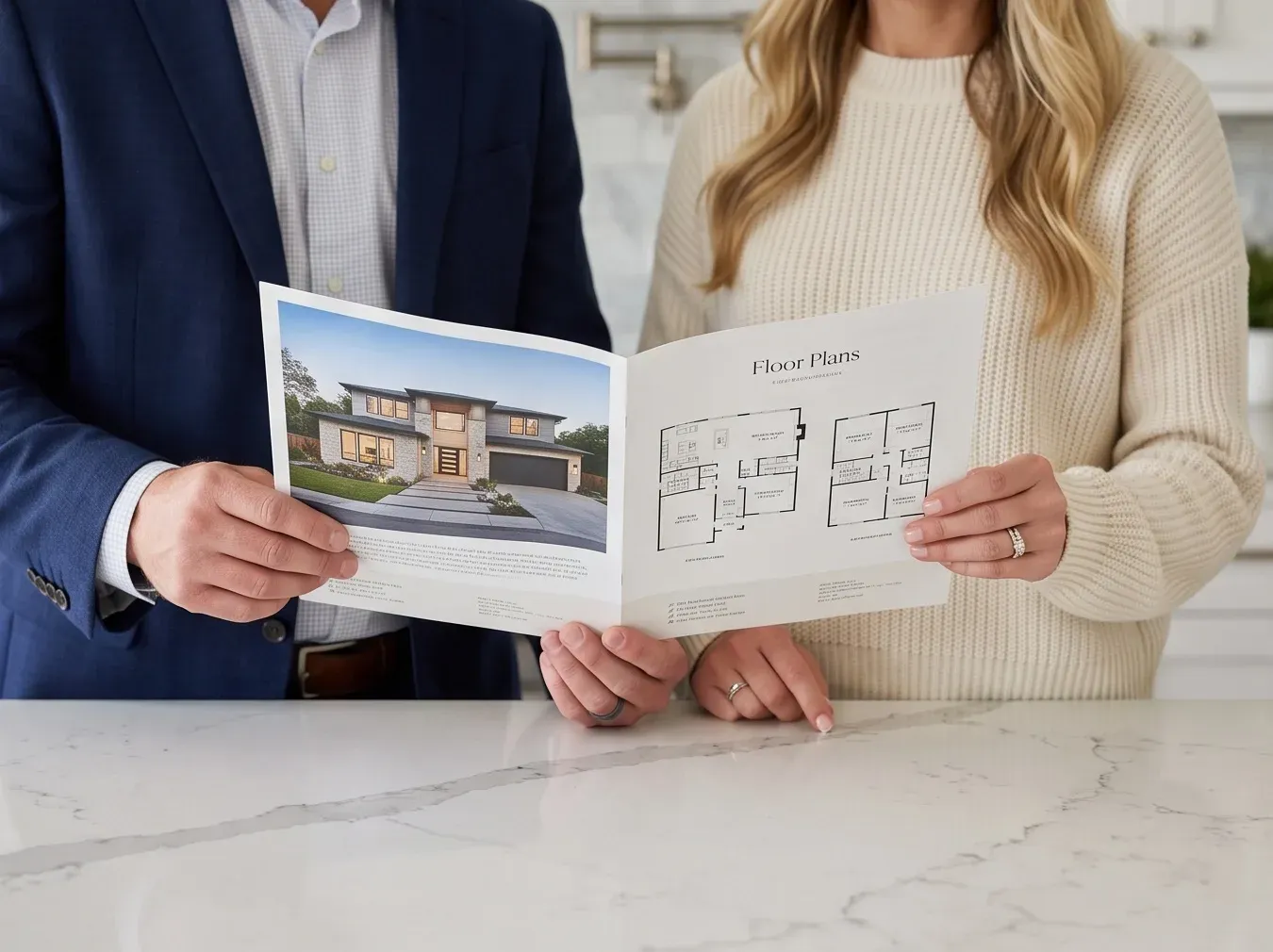
Every listing presentation in this market eventually hits the same small question: are we doing flyers or brochures? It sounds trivial. It isn’t — order the wrong one and you either leave a stack of glossy four-pagers untouched in a Ballston condo lobby, or you hand a single sheet to a buyer who is comparing your $2.4 million Potomac colonial against two others that came with a magazine.
We photograph listings across DC, Maryland, and Northern Virginia and print the flyers and brochures that go with them, and our honest answer is that most DMV listings need only a double-sided flyer. A 4-page brochure earns its place on luxury homes, new construction, historic properties with a story, and in listing presentations — and almost nowhere else.
The surprising part: at our prices the print difference is just $0.60 a copy. So the flyer-versus-brochure decision isn’t really about print cost. It’s about whether your listing has enough photos, floor plan, and story to fill four pages without padding. Here’s how to decide, by price point, property type, and marketing moment.
What’s the Difference Between a Real Estate Flyer and a Brochure?
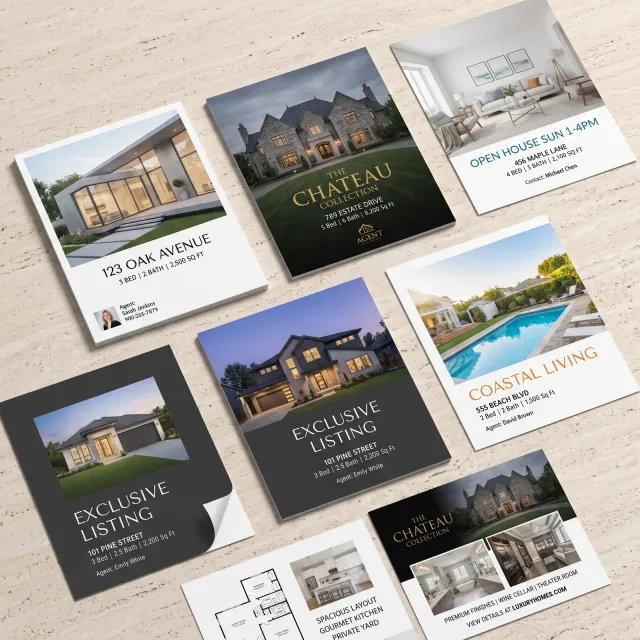
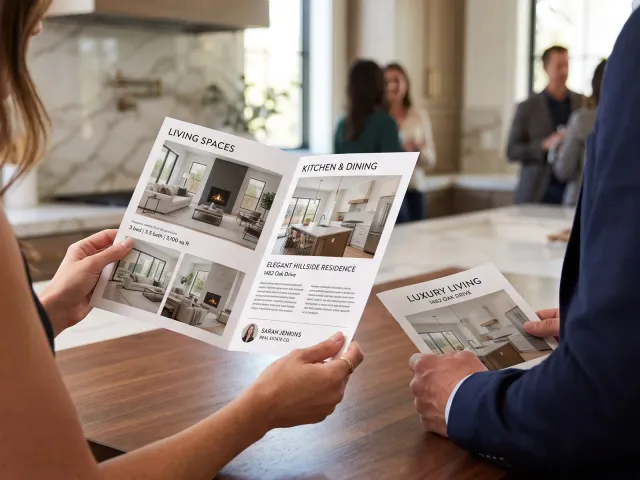
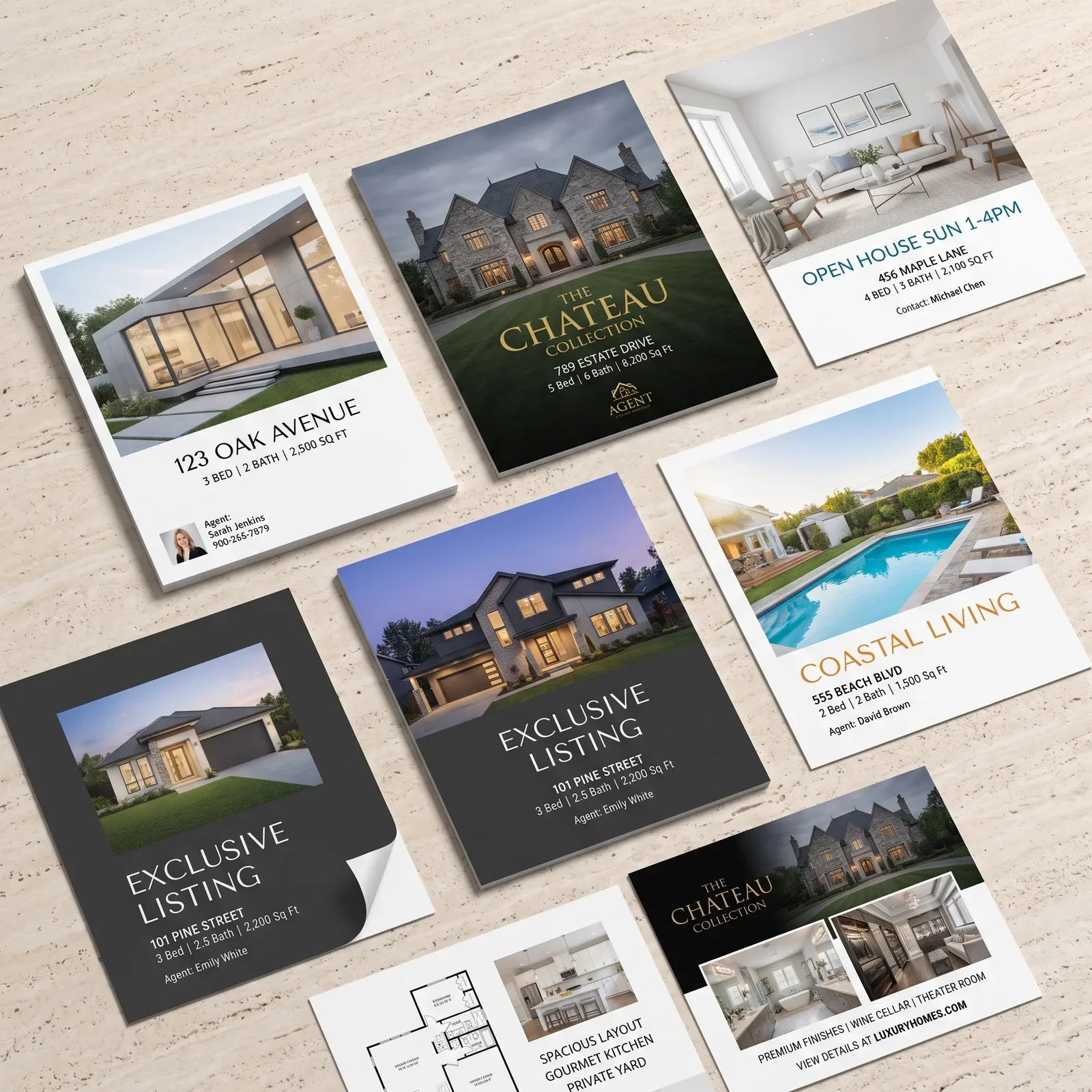
A listing flyer is one 8.5″ × 11″ sheet printed on both sides — hero photo and headline on the front, a few interiors, key features, the floor plan, and your contact details on the back. A brochure is four 8.5″ × 11″ pages: a cover, a two-page interior spread for photography and copy, and a back page for floor plans, neighborhood, and branding. Twice the canvas, roughly three times the photos.
Here’s how the two compare side by side, using our own print pricing for the cost row:
| Double-sided listing flyer | 4-page listing brochure | |
|---|---|---|
| Format | One 8.5″ × 11″ sheet, full color, printed both sides | Four 8.5″ × 11″ pages, full color |
| Pages | 2 (front and back) | 4 (cover, 2-page spread, back) |
| Photo capacity | Typically 4–8: one hero plus a strip or grid of interiors | Typically 12–20: full-bleed cover, a photo spread, detail shots |
| Copy room | Headline, price, 5–8 feature bullets, short blurb | Full property narrative, room-by-room highlights, neighborhood section |
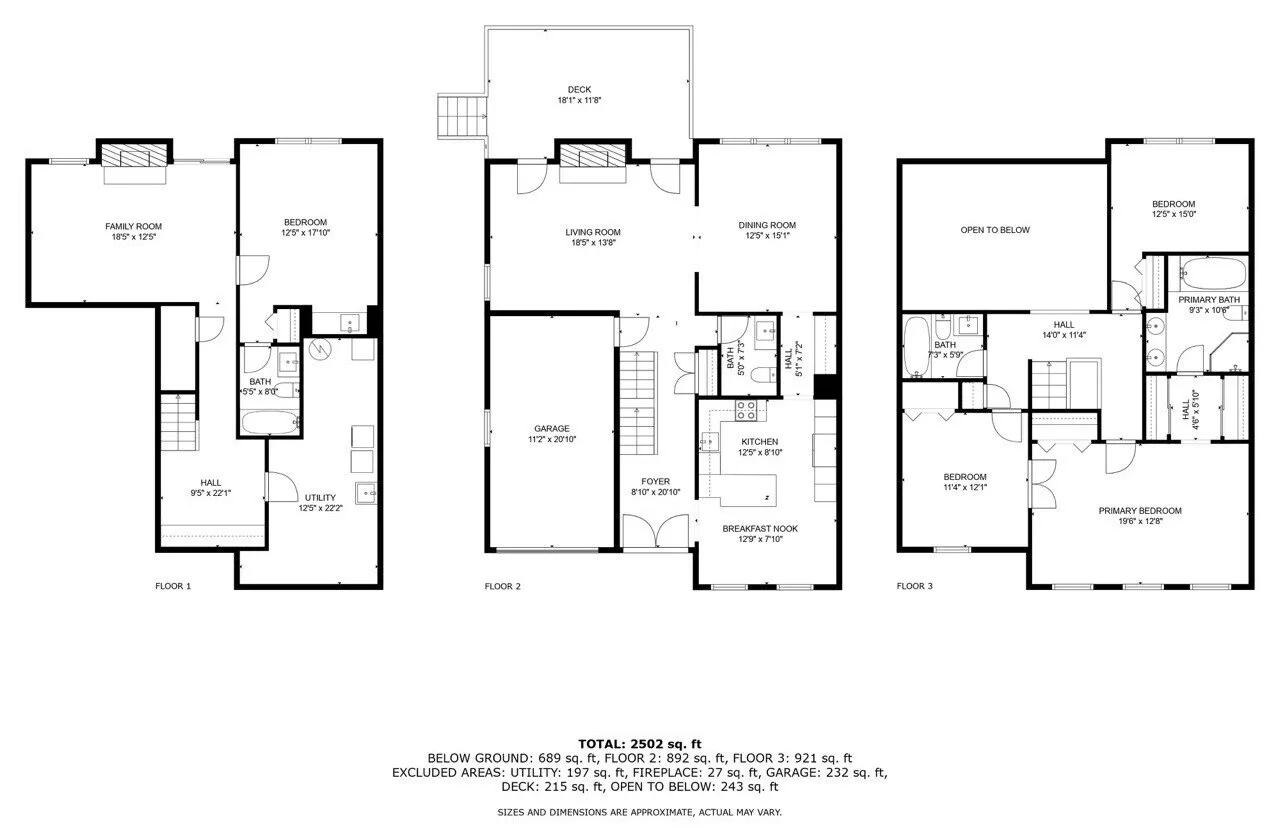
| Floor plan | Fits on the back, usually one level or a simplified whole-home view | Room for every level, including a basement or in-law unit |
| Best uses | Open houses, flyer boxes, neighborhood drops, most broker tours | Luxury listings, new construction, model homes, historic homes, listing presentations |
| UMedia cost | 25 for $45 · 50 for $90 ($1.80 each) | 25 for $60 · 50 for $120 ($2.40 each) |
| Lead time | Same day from a print-ready PDF; +24 hours if we design it | Same day from a print-ready PDF; +24 hours if we design it — but budget extra time to write the copy |
The last row is the one agents underestimate. Printing a brochure is no slower than printing a flyer. Writing one is. A flyer needs a headline and eight bullets; a brochure needs 300–500 words of copy that doesn’t read like it was stretched to fill space.
If you’re wondering what market rates look like beyond our own numbers, we broke that down separately in how much real estate flyers cost in DC, Virginia, and Maryland.
When Is a Double-Sided Flyer Enough?
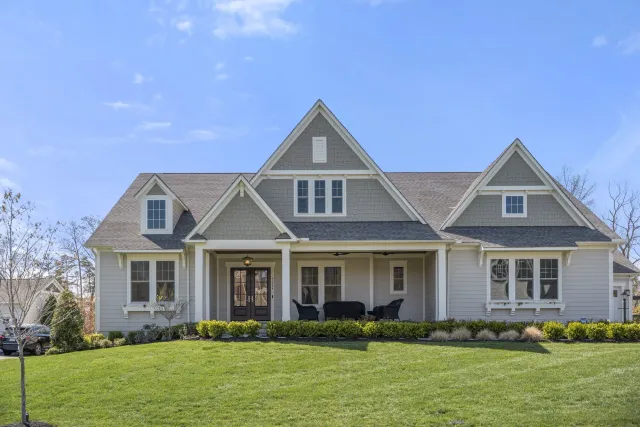
For the large majority of DMV listings — condos, townhomes, and most single-family homes — a double-sided flyer is all you need. It holds the hero shot, the features buyers ask about, the floor plan, and a QR code to everything else. If the listing’s story fits in eight bullets, a brochure just adds pages buyers skim past.
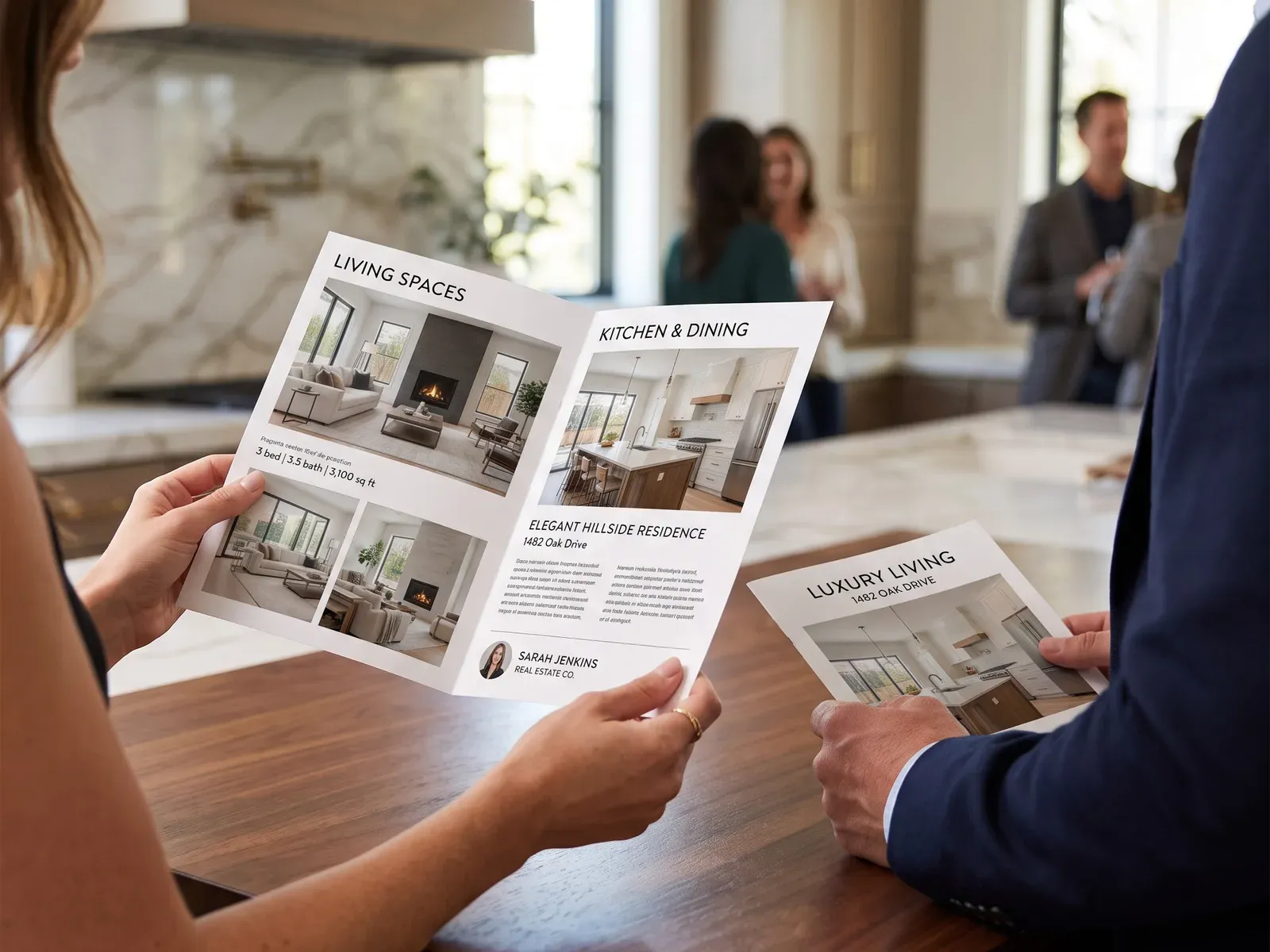
Situations where we’d tell you to stop at the flyer:
- Condos in Arlington, Clarendon, Ballston, and Rosslyn. A two-bedroom in a Clarendon high-rise sells on layout, finishes, building amenities, and walkability to the Metro. That’s a front and a back. Four pages of interior photos of a 1,100-square-foot unit starts to feel repetitive — the floor plan does more work than the fifth kitchen angle.
- Townhomes in Fairfax, Alexandria, Reston, and Rockville. Buyers are comparing specs across similar homes in the same community: bedrooms, baths, garage, updates, HOA. A clean flyer with a floor plan answers the comparison faster than a brochure does.
- Standard weekend open houses. The flyer’s job is to be the thing buyers take home and compare that evening. It has to be scannable, not literary.
- Flyer boxes on the sign post. Rowhouse streets in Capitol Hill, Del Ray, and Takoma Park get real foot traffic, and people grab a flyer on a walk. Box copies disappear, get rained on, and need restocking — a $1.80 flyer is the right unit for that.
- Neighborhood drops. Neighbors often know someone who wants to move onto the street. A flyer in their hands is cheap word-of-mouth.
- Rentals and leasing. Property managers need availability sheets they can update monthly. That’s a flyer.
What actually goes on it — the full field-by-field list — is in our open house flyer checklist.
When Does a 4-Page Brochure Earn Its Cost?
A brochure earns its cost when the listing has more to show than two pages can hold — typically luxury homes, new construction and model homes, historic properties with a genuine story, and any piece you’ll use to win the next listing. The test is simple: if you can fill four pages without repeating photos or padding copy, the extra $0.60 a copy is trivial.
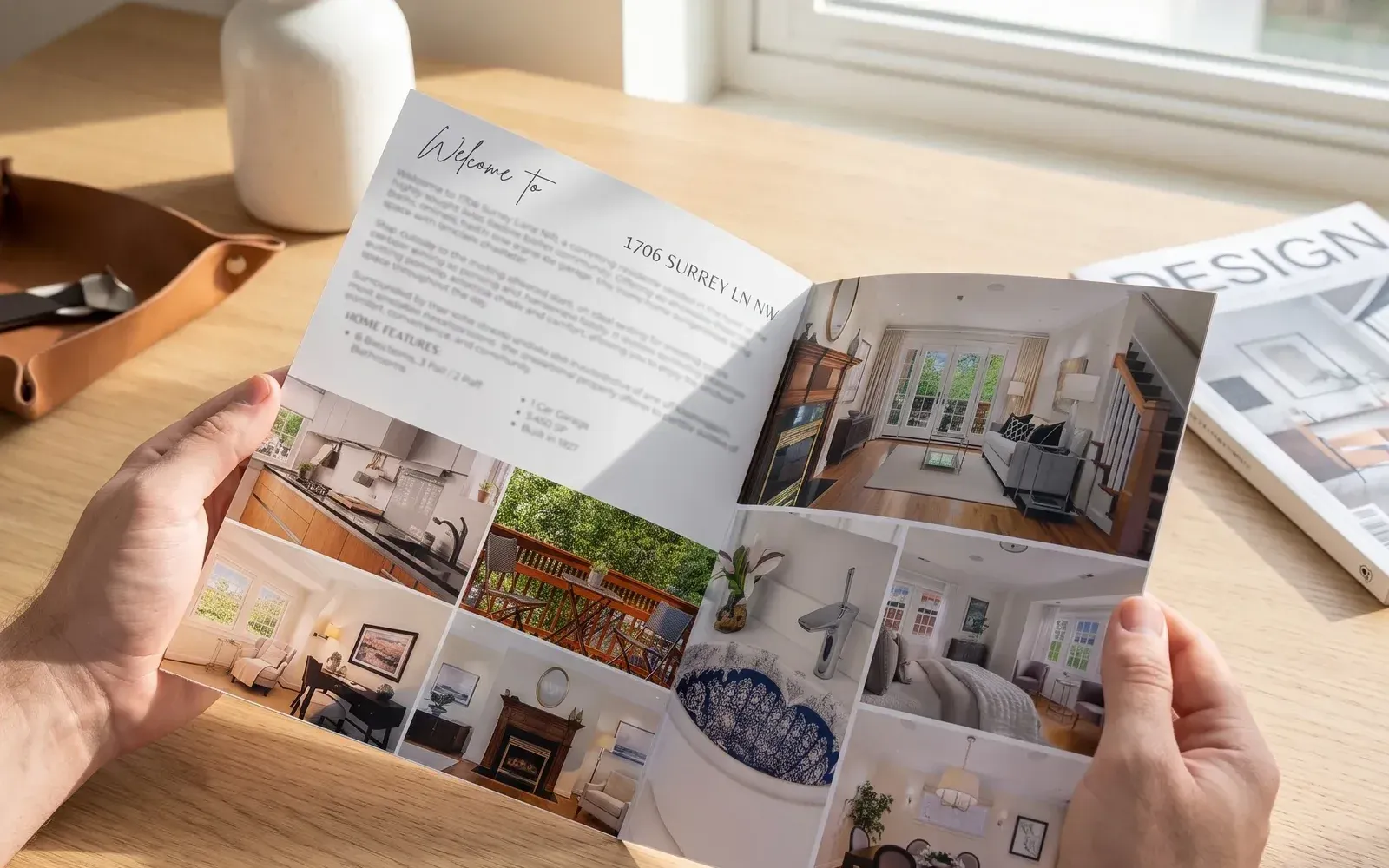
Luxury listings in McLean, Potomac, and Great Falls
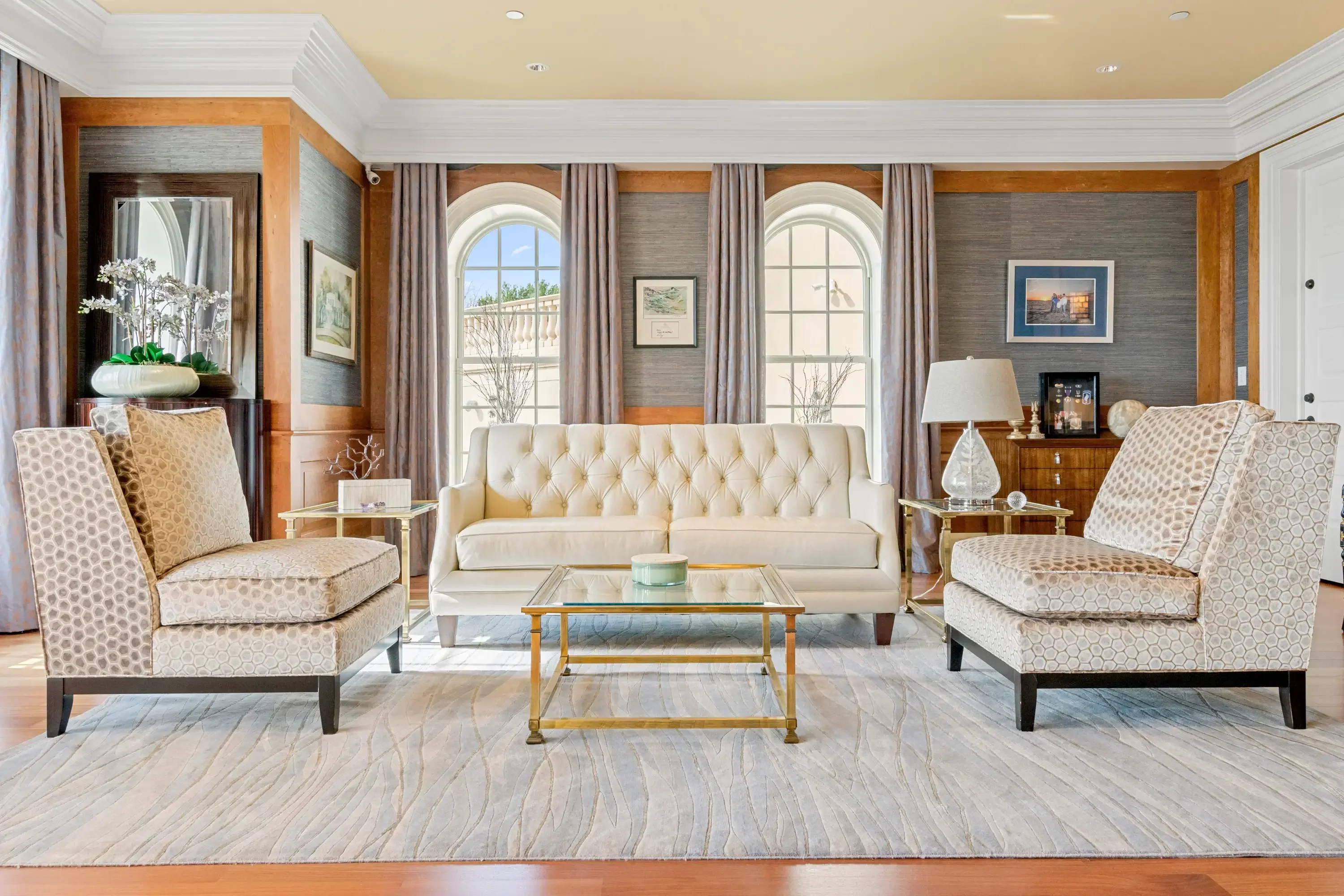
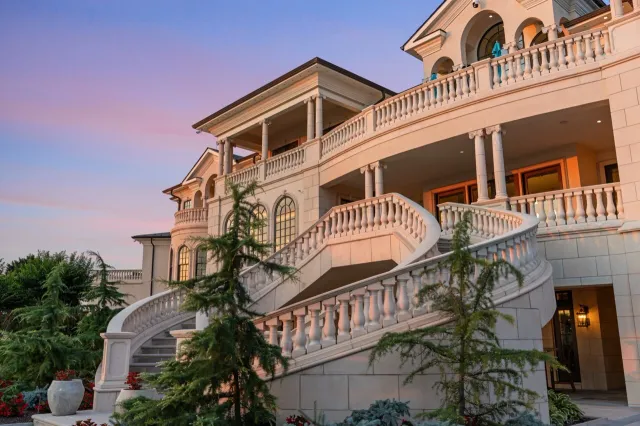
On a $2 million-plus home in McLean, Potomac, or Great Falls, the brochure isn’t a luxury — it’s table stakes. These homes have more rooms worth photographing than a flyer can hold: the primary suite, the lower-level rec room, the pool, the grounds, the twilight exterior. Buyers at this level are often comparing a short list of estates across several weekends, and the listing that comes with a proper brochure reads as the one that was marketed properly.
The seller notices too. On a listing where your commission is measured in tens of thousands, $120 for 50 brochures is the least expensive thing in your marketing plan — and the one the seller will physically hold.
New construction and model homes in Loudoun and Ashburn
Builders in Ashburn, Brambleton, and the rest of Loudoun County’s new-construction corridor are selling a community, not just a house: elevations, floor plan options, included features versus upgrades, amenities, school assignments. That’s brochure-length content. A model-home brochure also has a long shelf life — it sits in the sales center for months, unlike a resale flyer that’s obsolete after the first price change.
Historic rowhouses in Georgetown and Capitol Hill
A 19th-century Georgetown rowhouse or a Capitol Hill Victorian has a story a flyer can’t tell: the year it was built, what was restored versus replaced, original details like heart-pine floors and marble mantels, the garden, the permitted English basement unit. DC rowhouses also run three or four levels tall and narrow, which means a legible floor plan needs a page to itself. The back page of a brochure can show every level — including a rental-ready basement buyers will want to underwrite.
Broker tours and listing presentations
For luxury broker’s opens, a brochure signals that this listing gets serious marketing, and other agents carry it back to their buyers. And the most underrated use of all: a brochure from your last listing is your best listing-presentation prop. Hand a seller the actual printed piece from a comparable home and you’ve shown them — not told them — how you’ll market theirs.

Flyer or Brochure? A Quick Decision Guide by Price, Property, and Moment
Use a flyer by default and upgrade to a brochure only when the price point, property type, or moment calls for it. As a rule of thumb in this market: under roughly $1 million, flyer; $1–2 million, flyer unless the home has a real story; above $2 million, brochure. Property type and use can override price in either direction.
| Your situation | Pick | Why |
|---|---|---|
| Condo in Arlington, Bethesda, or DC, any price under ~$1M | Flyer | Layout, finishes, and building amenities fit on two sides |
| Townhome or single-family under ~$1M | Flyer | Buyers are comparing specs; the floor plan does the heavy lifting |
| $1–2M single-family with ordinary features | Flyer (brochure optional) | Upgrade only if you have 12+ strong photos and a real narrative |
| $2M+ home in McLean, Potomac, or Great Falls | Brochure | More rooms, grounds, and lifestyle than two pages can hold |
| Historic Georgetown or Capitol Hill rowhouse | Brochure | The history, restoration details, and multi-level floor plans need space |
| New-construction community or model home | Brochure, plus flyers per plan | Long shelf life; flyers update with inventory and incentives |
| Weekend open house, any listing | Flyer (brochure for luxury) | It’s the take-home comparison piece |
| Flyer box or neighborhood drop | Flyer | High-volume, low-attention; brochures are wasted here |
| Listing presentation leave-behind | Brochure | It’s your portfolio, printed |
| Commercial office, retail, or flex space | Flyer (brochure for larger offerings) | Tour handout with specs, floor plate, and contact |
| Rental or lease-up availability | Flyer | Needs frequent updates |
What About Builders, Developers, and Commercial Listings?
Builders usually need both formats; commercial brokers usually need a flyer. A builder’s community brochure carries the story — elevations, amenities, the included-features list — while a double-sided flyer per floor plan or quick-move-in home handles the details that change every few weeks. Commercial tours run on a one-sheet with specs, floor plate, and contact.
For builders and developers, the setup that works best in a sales center is a stack of community brochures on the model-home counter and a rack of per-plan flyers beside it. When the builder changes an incentive or releases a new phase, you reprint the flyers, not the brochure. Our builders and developers solutions page covers how print fits alongside model-home photography, video, and 3D tours.
For commercial brokers leasing office in Tysons or Reston, retail along a busy corridor, or flex space out near Chantilly, the offering flyer is the tour handout: photos, square footage, loading and parking specs, a floor plate, and the broker’s contact. A multi-page brochure makes sense for a larger offering — a whole building or a multi-tenant center — where each suite needs its own page.
How Many Flyers or Brochures Should You Print for an Open House?
For a single open house, 25 copies covers most DMV listings; order 50 if you’re running two weekends, restocking a flyer box, or listing in a high-traffic spring market. At our prices that’s $45 or $90 for flyers and $60 or $120 for brochures — cheap enough that running out is the bigger mistake than having leftovers.
Open houses aren’t dead, whatever you’ve heard. In NAR’s 2025 Profile of Home Buyers and Sellers, 48% of buyers used open houses as an information source, 43% rated them very useful, and agents hosted open houses for 59% of the sellers they represented. Those buyers leave with whatever you put in their hands.
A few practical rules for sizing the run:
- Match the run to the next change, not the whole listing period. A price improvement or new open-house date makes every leftover copy obsolete. Print for the next two weekends, not the next two months.
- Split formats on luxury listings. At a McLean open house, put 25 brochures out for serious buyers and keep 25 flyers for the flyer box and neighbors. You spend $105 instead of $120 and nobody’s brochure ends up in a puddle.
- Budget one extra batch for the broker’s open. If you’re doing a separate agent preview on a weekday, that crowd takes copies back to their buyers.
- Plan backward from Saturday. With our workflow, a print-ready PDF submitted by 12 PM is ready after 5 PM the same day. If you need design, allow 24 hours for the layout first — for a Saturday open house, order design by Thursday and you have a day of buffer.
Should Your Flyer Have a QR Code to a Property Website?
Yes — a QR code is how a two-page flyer holds 40 photos, a 3D tour, and a video. Print it on the back, near the floor plan, and point it at a single property website rather than the MLS listing or a portal page crowded with other homes. The flyer starts the conversation; the website finishes it.
This matters because paper is where buyers compare, but screens are where they dig in. The same NAR 2025 Profile found that among buyers who searched online, 81% rated photos very useful and 57% rated floor plans very useful — which is exactly why the floor plan belongs on the flyer’s back and the full gallery belongs one scan away. If your listing doesn’t have a floor plan yet, add one to the shoot; it’s the single most useful thing on the back of a flyer after the price.
Three rules for QR codes on print:
- Point it at a URL you control. Price changes and relistings shouldn’t break a code that’s already printed on 50 flyers.
- Test-scan the printed proof, not just the PDF on screen, and keep the code at least an inch square.
- Don’t reverse the flow into the MLS. Your flyer can carry your headshot, logo, and phone number. Your MLS photos can’t: BRIGHT’s Images Policy prohibits readable text and agent or brokerage contact information in listing images, and branded media is a $250 fine with no warning. Don’t upload the flyer as a listing photo — our BRIGHT MLS photo rules explainer covers the details.
When Is Neither a Flyer Nor a Brochure Worth It?
Skip print when there’s no in-person moment for it to serve. If a listing has no open house, no flyer box, and no broker tour — or it’s likely to go under contract before the first weekend — printed pieces mostly end up in recycling. Print is a supplement to online marketing, not a substitute: per NAR, 52% of buyers found the home they bought on the internet.
It’s also telling that NAR’s 2025 data shows agents used direct mail — flyers, postcards, and the like — to market only 9% of homes. Print works best as the physical extension of an open house, not as a standalone channel. Cases where we’d tell you to save the $45:
- Coming-soon and office-exclusive listings with no public showings yet. Print when there’s a date on the calendar.
- Hot spring listings with offer deadlines. If a well-priced Arlington or DC listing is going to see offers on Monday, you need one weekend of flyers, not a brochure run.
- Buildings that restrict what you can leave out. Many high-rise condo buildings in Arlington, Bethesda, and DC limit lobby materials and flyer boxes. Check with management before you order 50.
- Listings with weak photos. Printing mediocre photos at 8.5″ × 11″ just makes them bigger. Fix the photography first; print second.
- A brochure you can’t fill. If you have eight good photos and five features, a brochure will look padded. A clean flyer is the more premium choice.
How Do You Get a Flyer or Brochure Printed Fast in the DMV?
The fastest path is a print-ready PDF submitted by 12 PM — printed and ready after 5 PM the same day. You can build that file yourself, bring one from your brokerage’s tools, or have our designer build it for $99. Then pick up at our Chantilly, VA kiosk or have it delivered anywhere in the DMV for $99 flat.
The three ways to get there:
- Design it yourself, free. Our free Canva 4-page brochure template and step-by-step PDF guide walks you through dropping in your photos, editing the text, and exporting a print-ready PDF. It’s built as a brochure, so it’s the natural starting point when you’ve decided a four-page piece fits your listing.
- Bring your own file. Any 8.5″ × 11″ print-ready PDF works — from Canva, Adobe, or your brokerage’s templates.
- Have us design it. Professional Print Design is $99 one-time per design, and we return a print-ready PDF within 24 hours. The file is yours to reuse — reprint it after a price change, email it, or post it to the property website without paying again.
Pickup is at our Chantilly kiosk after 5 PM on the print date or any time the next day. If Chantilly is out of your way — say you’re prepping a Capitol Hill open house — add delivery for $99 and it comes to your listing or office. Full specs and ordering are on our flyer and brochure printing page.
The short version: default to a flyer, put the floor plan and a QR code on the back, and save the brochure for the listings with enough story to fill it. At $0.60 a copy, the brochure is never too expensive — it’s only ever too empty.