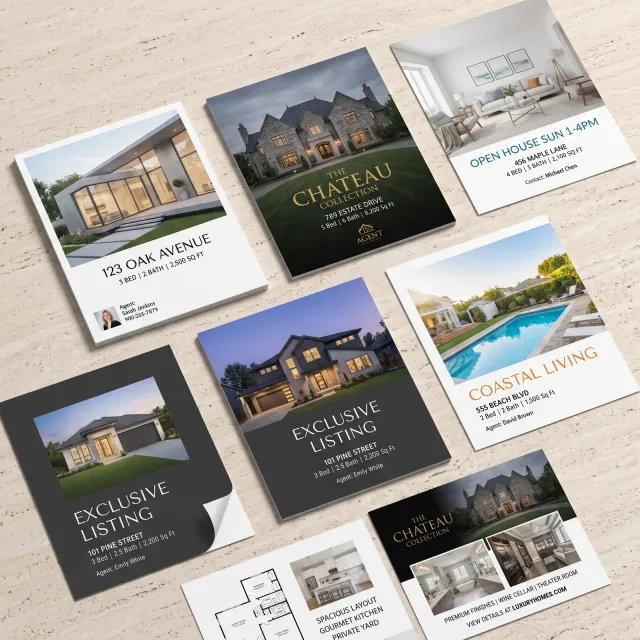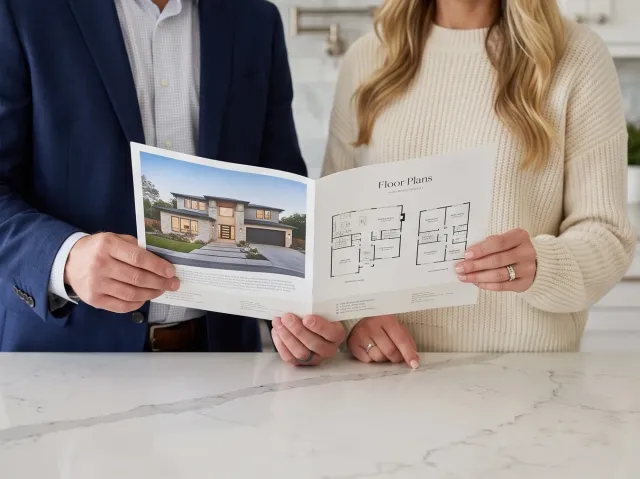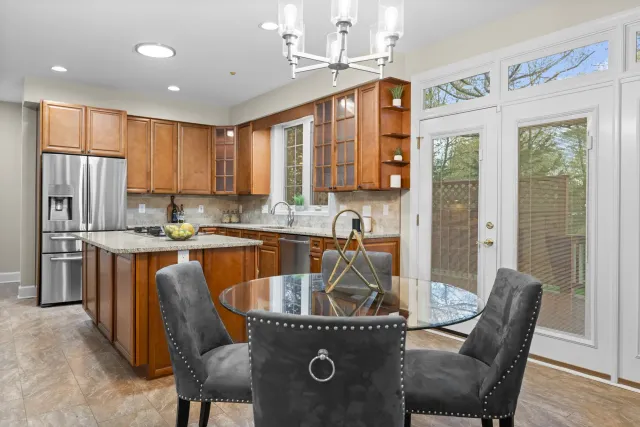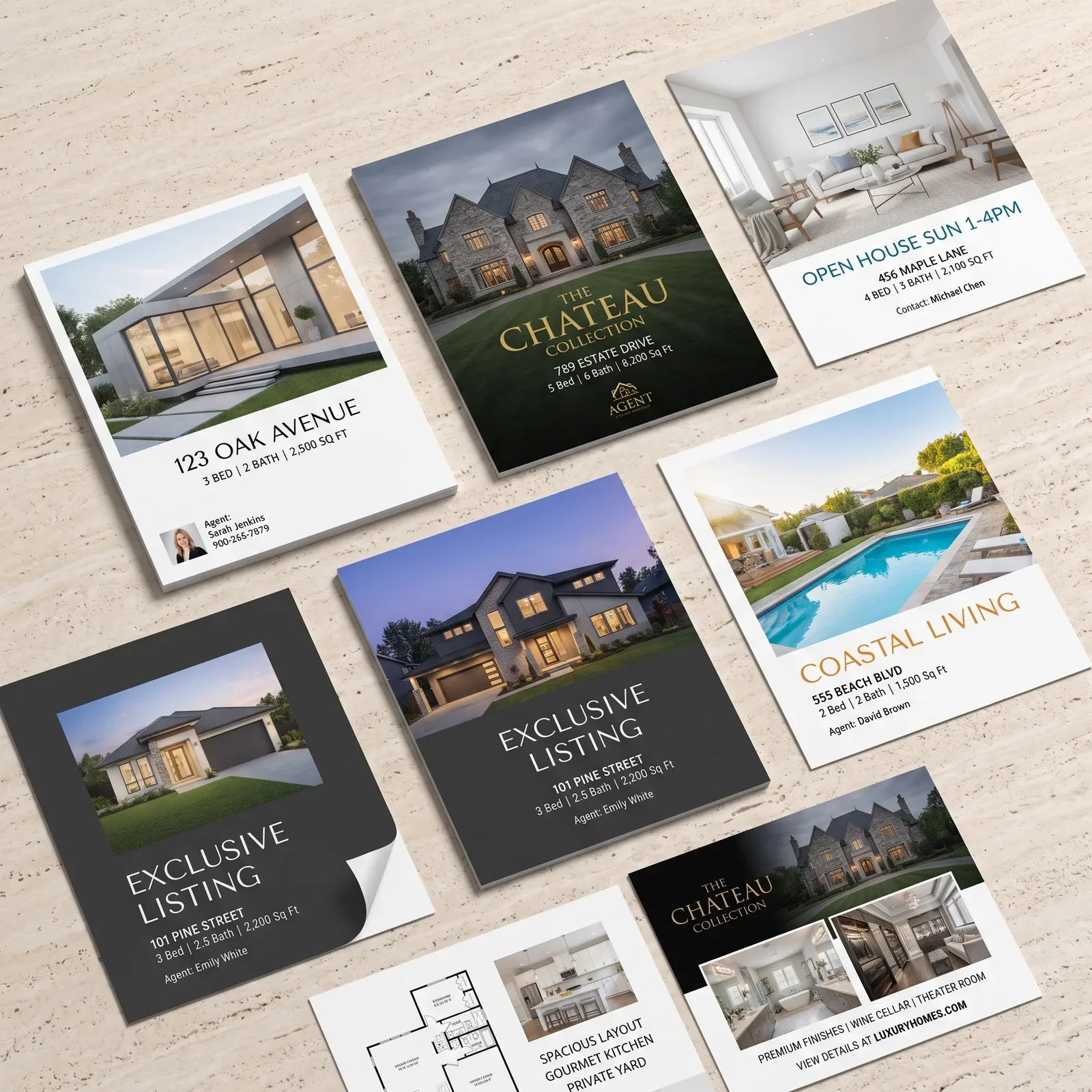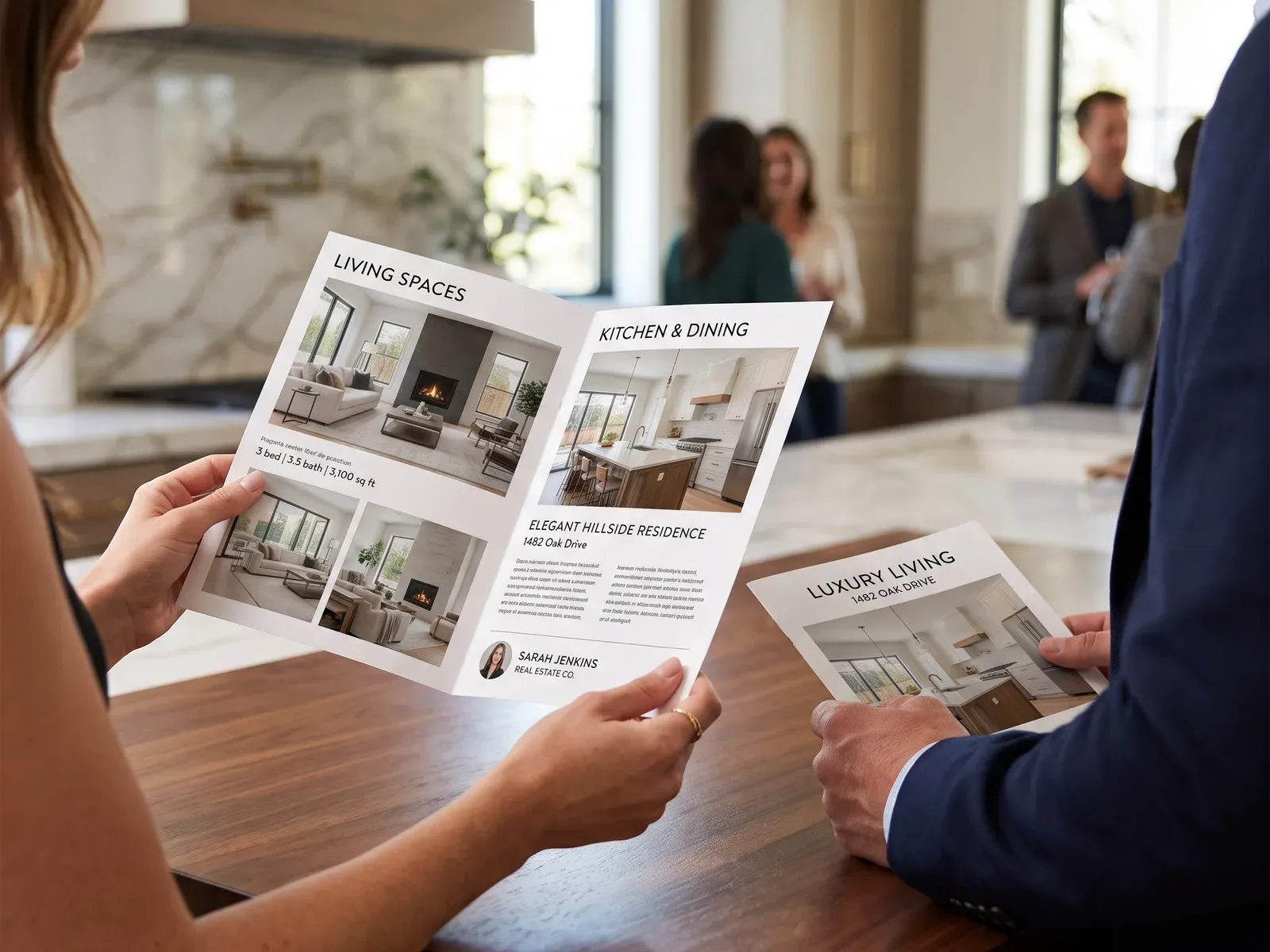
Walk into any Sunday open house in Clarendon, Bethesda, or Old Town Alexandria and you’ll find the same thing on the kitchen island: a stack of flyers. Some get folded into a tote bag and pulled back out that night when two buyers compare notes. Most get left behind — or taken and forgotten because they looked like every other flyer from the afternoon’s five open houses.
The difference is almost never the paper. It’s what’s on the page. After producing listing media across DC, Maryland, and Northern Virginia, we see the same pattern constantly: agents spend real money on photography, then compress it onto a flyer that buries the best photo, skips the floor plan, and forgets the brokerage disclosure their state requires.
This is the checklist we’d hand any DMV agent building a standard double-sided 8.5″ × 11″ listing flyer — what goes on the front, what goes on the back, what Virginia, Maryland, and DC rules require, and the print specs that keep your file from coming back with chopped-off margins.
What Should You Put on an Open House Flyer?
An open house flyer needs one large hero photo, a headline, the address, price, beds/baths/square footage, and the open house date on the front, and four to six interior photos, a floor plan, five to seven key features, neighborhood notes, a QR code, and your agent and brokerage block on the back. That’s roughly ten elements across two sides — anything more and the flyer stops being scannable.
Here’s the whole checklist at a glance:
| Front of the flyer | Back of the flyer |
|---|---|
| Hero photo — the single best image, 50–60% of the page | 4–6 interior photos — kitchen, living, primary suite, one standout |
| Headline — specific, 3–8 words | Floor plan — simplified, with room dimensions |
| Address — street, city, state, ZIP | 5–7 key features — facts, not adjectives |
| Price — list price, large and clear | Neighborhood & commute — Metro, drive times, walkable spots |
| Beds / baths / sqft — plus lot size or condo fee if relevant | QR code — to the property website, labeled |
| Open house date & time — if the flyer is event-specific | Agent block — name, photo, phone, email, brokerage name and office phone |
| Brokerage name — small, but present | Disclosures — “virtually staged,” “buyer to verify,” Equal Housing logo if your broker requires it |
The rule we give agents: the front sells the visit, the back answers the questions. Buyers decide in about the time it takes to glance at the front whether this is a flyer worth keeping. The back is what they read at 9 PM when they’re deciding whether to call you.
What Goes on the Front of a Listing Flyer?
The front of a listing flyer should be mostly photo — 50 to 60% of the page — with the headline, address, price, and core specs arranged around it so a buyer can absorb all five in under five seconds. If the front has more than about 40 words of text, it’s doing the back’s job.
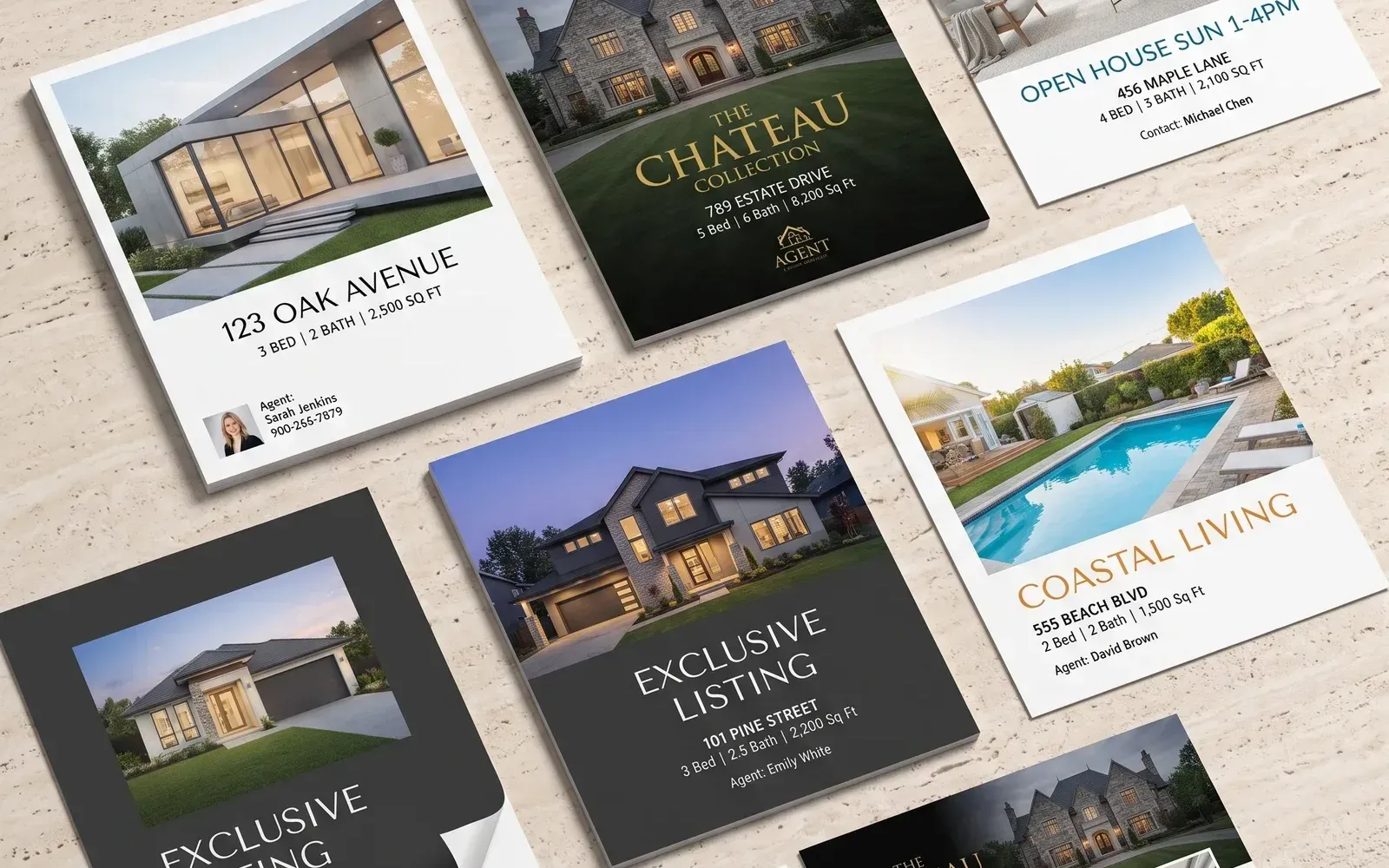
The hero photo: pick the one image that sells the visit
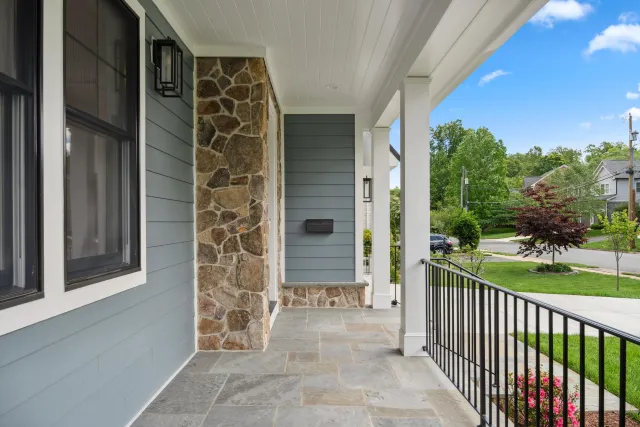
Your hero is almost always the front exterior or the single best interior — and in our experience, which one wins depends on the house:
- Detached homes with curb appeal (a Chevy Chase colonial, a Vienna farmhouse): lead with the exterior. It’s what buyers will recognize when they pull up.
- Condos and high-rises (Rosslyn, Crystal City, Downtown Bethesda): the exterior is a building buyers can’t distinguish from the one next door. Lead with the living room view, the kitchen, or the terrace.
- DC rowhouses: the facade is often the charm — a painted Capitol Hill brick front works. If the block is crowded with cars, lead with the renovated kitchen instead.
- Twilight shots make excellent flyer heroes because they read as premium even at small sizes — though the “76% more views” figure that circulates online comes from a single vendor’s claim, not independent research.
One thing that surprises agents: the flyer is where your branding belongs. BRIGHT MLS bans signs, logos, text overlays, and agent contact info from listing photos (we covered that in our BRIGHT MLS photo rules explainer), but a printed flyer is your advertisement. Put the headline over the photo, add your logo, go wild — within the legal rules below.
Photo quality matters more on paper than on a phone. A slightly soft image looks fine on a phone screen; printed 8 inches across, every blown-out window and dark corner shows. Professional listing photography delivered at full resolution is the single biggest quality lever on the whole piece.
The headline: specific beats superlative
“Stunning Must-See Home!” tells a buyer nothing, and they’ve read it on four flyers today. A good headline names the one thing that makes this listing different:
- “Walk to Clarendon Metro — 2BR with Private Terrace”
- “Renovated 1920s Rowhouse, Two Blocks from Eastern Market”
- “Quarter-Acre Lot on a Cul-de-sac in Walt Whitman Cluster” (school cluster names are factual — just add “buyer to verify” on the back)
Keep it to three to eight words plus an optional subhead. If you need a comma and a semicolon, you have two headlines.
Address, price, and the numbers
Below or beside the photo, in the largest text on the page after the headline:
- Full address including ZIP — buyers photograph flyers and search the address later.
- List price. Leaving it off doesn’t create intrigue; it creates a reason to skip you. Buyers at a Saturday open house are comparing price per square foot across four homes.
- Beds / baths / finished square footage. In the DMV, add the numbers local buyers screen on: condo or HOA fee for Arlington and DC condos, lot size for single-family homes in Fairfax or Montgomery County, and garage or deeded parking anywhere near a Metro.
- Open house date and time — only if the flyer is event-specific. If you’ll reuse the stack for broker tours and the flyer box, leave it off and use a sticker or insert instead.
What Goes on the Back of an Open House Flyer?
The back of the flyer carries the detail: four to six interior photos, a floor plan, five to seven key features, neighborhood and commute notes, a QR code, and the agent-and-brokerage block. It’s the side buyers read at home, so it should answer the questions they forgot to ask at the open house.
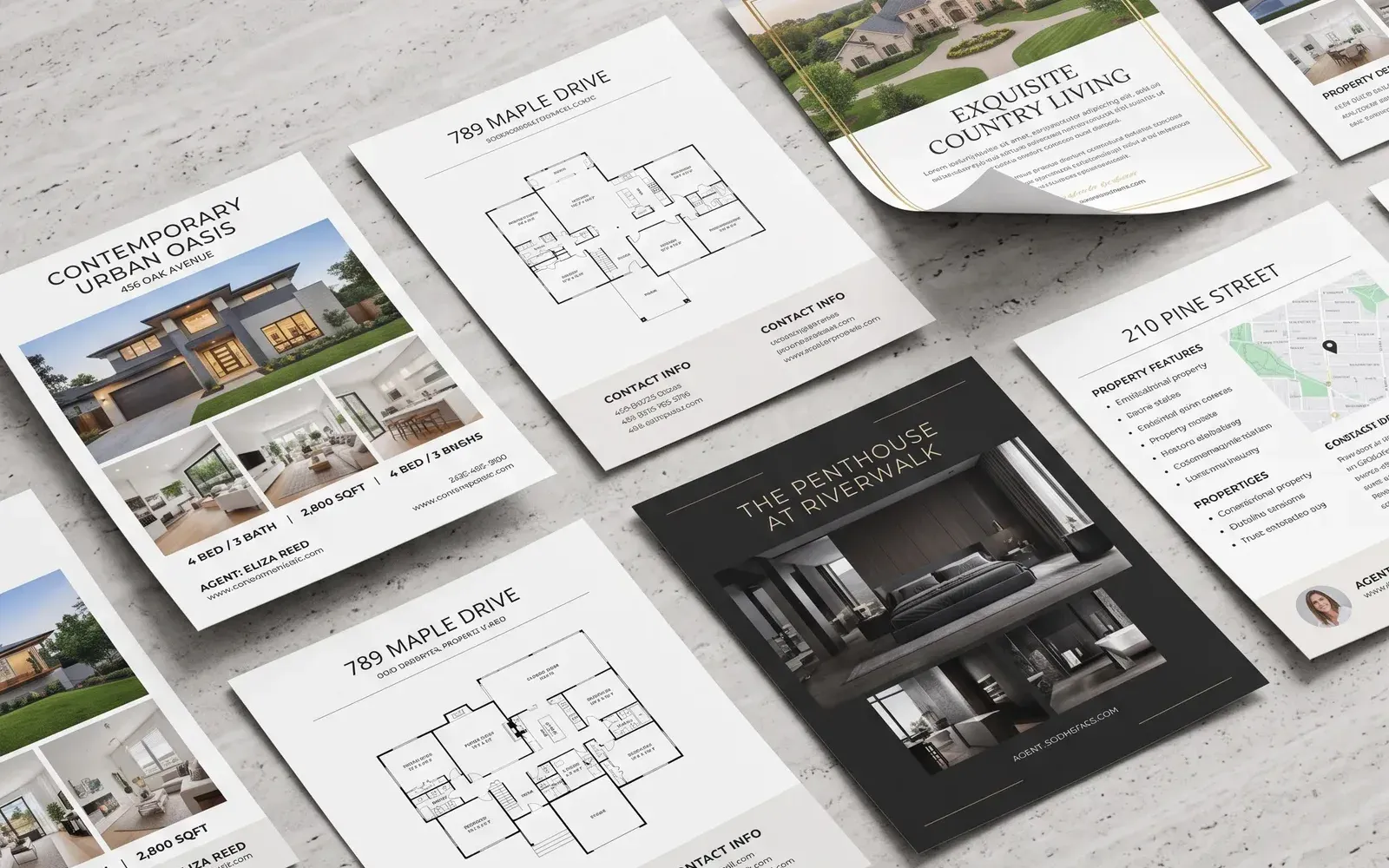
Four to six interior photos
Pick the rooms buyers make decisions on: kitchen, main living space, primary bedroom, primary bath, plus one or two standouts — the finished basement, the screened porch, the rooftop deck. Resist the urge to cram in twelve. At twelve photos on half a page, each one is the size of a postage stamp and none of them sells anything.
The floor plan
This is the element most flyers skip and the one we’d add first. In NAR’s 2024 Profile of Home Buyers and Sellers, buyers ranked floor plans the third most useful listing-website feature (31%), behind only photos (41%) and detailed property information. On paper it’s even more useful: it’s how two buyers comparing three homes that evening remember which one had the awkward primary suite. A simplified, measured floor plan — one level or all levels — with room dimensions turns your flyer into a reference document instead of a souvenir.
Five to seven key features — facts, not adjectives
Write features the way a buyer’s agent would read them aloud: specific and checkable.
- Weak: “Gorgeous updated kitchen” · “Tons of storage” · “Great location”
- Strong: “2024 kitchen: quartz, Bosch appliances, 9-ft island” · “Two walk-in closets + unfinished attic” · “0.4 mi to Bethesda Metro (Red Line)”
Include the unglamorous items DMV buyers ask about: roof and HVAC age, EV charger, deeded parking, storage unit, pet policy for condos.
Neighborhood, commute, and schools
This is where a DMV flyer earns its keep — and where generic templates fail. Buyers here care about the commute in specific terms:
- Metro: “8-minute walk to Ballston (Orange/Silver)” beats “near Metro.”
- Drive times to major employers: the Pentagon, Tysons, Reston Town Center, NIH, Fort Meade, Joint Base Andrews — whichever is relevant for the listing’s likely buyers. Plenty of DMV buyers are federal employees, military, or contractors, and they think in commute minutes.
- Walkable anchors: King Street in Old Town, Bethesda Row, Wilson Blvd in Clarendon, the Wharf.
- Schools: list assigned schools as facts, with “buyer to verify” — boundary maps change.
The QR code
Every flyer should carry a QR code that opens a single property website for the listing — the full gallery, 3D tour, video, and floor plan that couldn’t fit on paper. Don’t point it at your brokerage homepage or a portal page surrounded by “similar homes.” Practical rules:
- Print it at least about 1 inch square, on a white background, not over a photo.
- Label it: “Scan for the full tour and floor plan.”
- Test it on two phones before you print — the fifty-flyer stack with a dead link is a rite of passage nobody needs.
The agent-and-brokerage block
Your name, headshot, direct phone, email — and, non-negotiably, your brokerage’s name and office contact information. That last part is a legal requirement in all three DMV jurisdictions, covered next.
What Do Virginia, Maryland, and DC Require on a Real Estate Flyer?
All three DMV jurisdictions require the brokerage’s name on real estate advertising, and a printed listing flyer is advertising. Virginia also requires the office contact information; Maryland and DC require the broker’s phone number whenever an agent’s own phone or name appears. Your managing broker may add their own requirements on top — ask before you print.
| Jurisdiction | Rule | What it requires on your flyer |
|---|---|---|
| Virginia | 18VAC135-20-190 | The firm’s licensed name “clearly and legibly displayed on all advertising,” plus a “clear, legible, and conspicuous” disclosure with the firm’s name and office contact information. Advertised property info must match the property’s condition and current contract status. |
| Maryland | COMAR 09.11.02.01 | No advertising without “the broker’s name or the company name as it appears on the license.” An agent’s individual phone or email may appear only if the broker’s or branch office manager’s phone number also appears. |
| Washington, DC | 17 DCMR 2609.6 | An agent’s name may not appear in an advertisement without the brokerage company name and the main phone number of the brokerage or branch office. |
| Federal (all three) | Fair Housing Act, 42 U.S.C. 3604(c) | No ad may indicate a preference, limitation, or discrimination based on race, color, religion, sex, handicap, familial status, or national origin. |
What that means in practice:
- Put the brokerage name and office phone in the agent block on every flyer, in all three jurisdictions. A tiny logo alone isn’t a safe substitute for the licensed name.
- Update or pull flyers when status changes. Virginia’s rule explicitly ties advertised information to “current contract status” — a flyer box still full of “Just Listed” sheets two weeks after ratification is the kind of mismatch that provision is about.
- Describe the property, not the buyer. “Perfect for a young family” and “ideal for empty-nesters” are the phrases to cut. “Three bedrooms on one level” and “fenced backyard” say the same thing without the fair-housing exposure.
We’re photographers, not attorneys — these are the rules as published, and your brokerage’s compliance policy is the final word.
Disclose virtual staging on the flyer, too
If any photo on the flyer is virtually staged, label it on the flyer — a small “Virtually staged” caption on the image. BRIGHT’s Images Policy already requires virtual staging to be disclosed in the MLS, and it’s hard to argue a printed flyer should be held to a lower standard than the listing it advertises. The bigger risk is practical: a buyer who scans the QR code, sees the staged living room, and then walks into the empty one at the open house feels misled if nothing told them. A four-word caption prevents that.
What Are the Most Common Open House Flyer Mistakes?
The most common mistakes are too many photos, a missing floor plan, vague features, a missing brokerage disclosure, and a file built without bleed — and nearly all of them come from pasting listing content into a template without editing it for paper. Here’s what we see most often:
- Twelve tiny photos instead of five good ones. Pick the best, size them up.
- The MLS description pasted in whole. Two hundred words of “sun-drenched” in 8-point type. Nobody reads it. Use five to seven specific features instead.
- No floor plan. The one element most flyers leave out.
- Screen-resolution photos. MLS-sized files are optimized for screens and go soft at full-page width. Ask your photographer for full-resolution files.
- Missing or tiny brokerage info. A legal requirement in VA, MD, and DC — not a design choice.
- Superlatives instead of numbers. “Huge yard” vs. “0.31-acre fenced lot.” Buyers trust the second one.
- Stale information. Old price, old open-house date, or still circulating after the house went under contract.
- No bleed, no safe zone. White slivers at the edges and a phone number trimmed in half.
What Print Specs Does an Open House Flyer File Need?
A print-ready open house flyer is a PDF with 8.5″ × 11″ pages plus 0.125″ of bleed on every side — 8.75″ × 11.25″ per page — with images at 300 dpi at their printed size, fonts embedded, and all text kept at least 0.125″ inside the trim line. Get those four things right and the file prints the way it looks on screen.
| Spec | What to set | Why it matters |
|---|---|---|
| Trim size | 8.5″ × 11″ | Standard letter — fits flyer boxes, folders, and bags |
| Bleed | 0.125″ on all sides (file = 8.75″ × 11.25″) | Photos and color blocks that run to the edge won’t leave white slivers after trimming |
| Safe zone | Keep text and logos ≥ 0.125″ inside the trim | Protects the headline, phone number, and QR code from the blade |
| Image resolution | 300 dpi at printed size | A full-width hero needs a large original file — roughly 2,550 pixels wide for 8.5″ |
| Fonts | Embedded or outlined | Prevents font substitution on the printer’s end |
| Pages | 2 (front and back) in one PDF | Keeps sides in the right order |
The 300 dpi math is worth doing once: an 8.5″-wide hero at 300 dpi needs about 2,550 pixels across. Many MLS-optimized files are smaller than that — so pull flyer photos from the full-resolution originals, not from the MLS.
How Do You Get an Open House Flyer Made and Printed Fast?
You have two realistic paths: design it yourself in Canva or your brokerage’s template system and send a print-ready PDF to a printer, or have a designer build it from your photos and listing details. For a Saturday open house, aim to have the final PDF approved by Thursday or Friday morning.
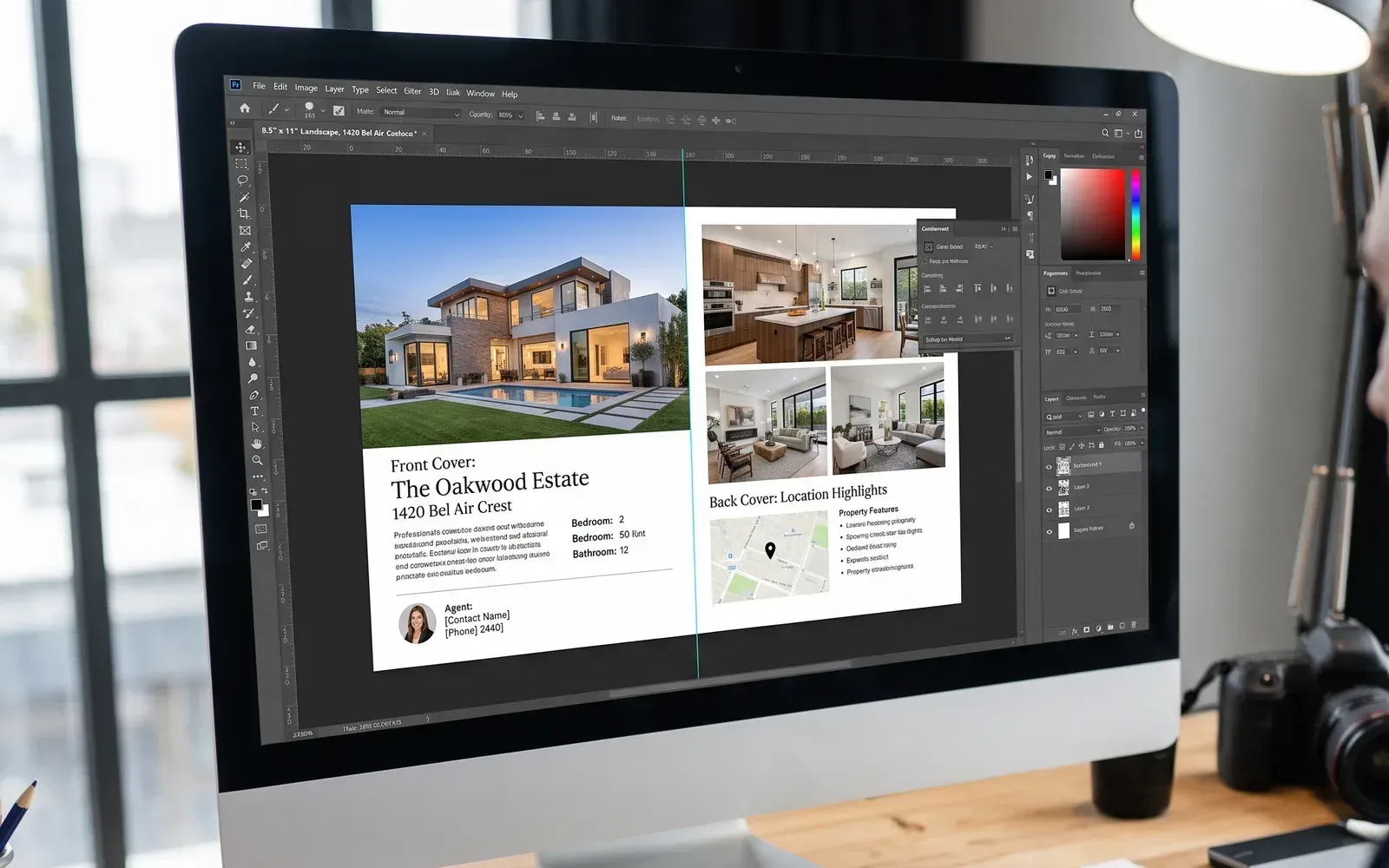
A quick note on format before you start: a double-sided flyer is the right piece for most open houses, flyer boxes, and neighborhood drops. For luxury listings and new construction that need more room, a 4-page brochure makes more sense — we break that decision down in listing flyer vs. brochure. And if you’re budgeting across DIY, online printers, and local shops, see our breakdown of what real estate flyers cost in DC, Virginia, and Maryland.
Doing it yourself. Canva and brokerage template systems work fine if you follow the checklist above and the print specs in the table. We offer a free Canva template and step-by-step PDF guide — note that it’s built as a 4-page brochure, not a single-sheet flyer, so it’s the right starting point if you’re stepping up to a brochure. Whatever you use, export as a print PDF with bleed.
Having it designed. If your time is worth more than an afternoon in Canva, UMedia’s Professional Print Design is $99 one-time per design, with a print-ready PDF back within 24 hours. The file is yours to keep — reprint it, email it, or post it on social media.
Printing. Through our same-day flyer and brochure printing, double-sided full-color 8.5″ × 11″ listing flyers are $45 for 25 or $90 for 50. Send a print-ready PDF by 12 PM and they’re ready after 5 PM the same day — pick up at our Chantilly, VA kiosk after 5 PM or any time the next day, or add $99 flat delivery anywhere in the DMV.
How many to print? For a typical open house, 25 covers it; a busy spring weekend in a hot Arlington or Bethesda neighborhood, a flyer box that restocks all week, or a combined broker tour and open house is where 50 makes sense. And because stale flyers are both a marketing problem and — in Virginia — a regulatory one, a smaller run you reprint after a price change beats a big stack you’re stuck with.
The honest summary: an open house flyer doesn’t need to be clever. It needs one great photo, the numbers buyers screen on, a floor plan, specific features, a working QR code, and the brokerage info your jurisdiction requires. Get those right and yours is the flyer that makes it home.